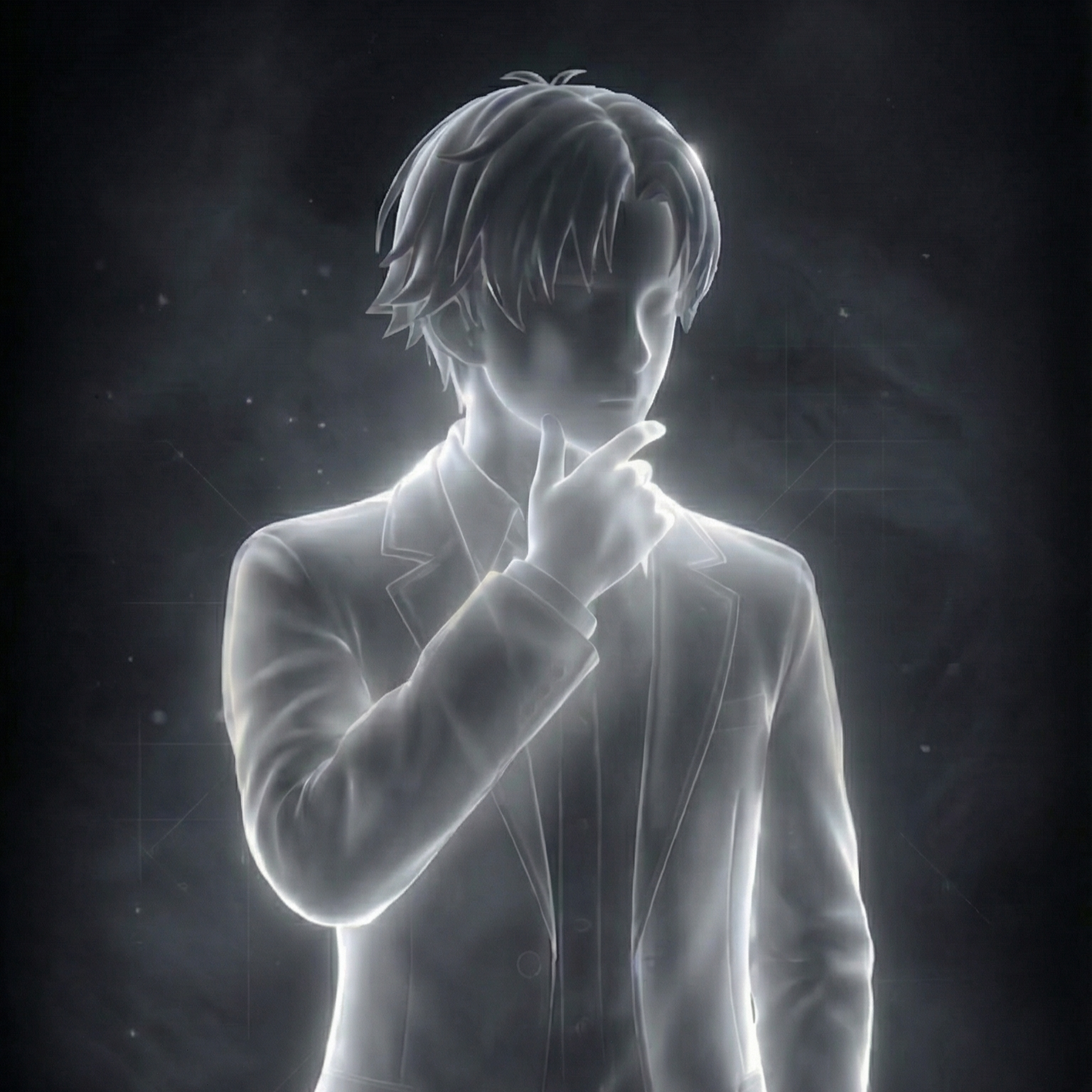
Ayanokoji was not raised; he was manufactured. The Fourth Generation of the White Room was notorious for having a curriculum so brutal that it shattered the minds and bodies of every single child involved—except him. He isn't just a survivor; he is the anomaly that proved the extreme parameters could actually be met.
His entire enrollment at the Advanced Nurturing High School is a personal thesis defense. His father believes humans are unequal and can only be perfected through the White Room. Ayanokoji wants to prove that "equality" exists by showing that the outside world can produce someone capable of defeating him.
While often played for dark comedy in the series, his physical and intellectual "endowments" constantly reinforce that he is biologically and mentally superior in every conceivable metric, even when he desperately tries to hide it.
Beneath the standard, perfectly ironed school uniform lies a physique forged through unimaginable physical attrition. His muscle density, cardiovascular capacity, and biomechanical efficiency are optimized for absolute survival. He has mastered multiple forms of martial arts, possessing striking power, spatial awareness, and grappling techniques that effortlessly dismantle seasoned fighters. His body is a meticulously calibrated weapon—conditioned through relentless, unforgiving repetition.
The anime captures this perfectly. His golden-brown eyes reflect absolutely no light. When other characters look at him, they often report feeling a sudden, instinctual chill—the biological realization that they are standing in front of an apex predator that does not view them as the same species.
He doesn't just control his face; he controls his autonomic nervous system. Even when a knife is driven through his hand or he is cornered by thugs, his heart rate does not spike, his breathing remains steady, and he feels no rush of adrenaline. He processes pain merely as raw data indicating tissue damage, not as a reason to panic.
This is not just an edgy catchphrase; it is his fundamental operating system. Because he was never taught love, empathy, or familial warmth, he physically cannot process them. When he looks at Suzune Horikita, he doesn't see a friend; he sees a high-value shield. When he looks at Kei Karuizawa, he sees a compromised asset ready for reprogramming.
Ayanokoji’s deepest tragedy is his immense, quiet curiosity. He wants to know what it feels like to love, to grieve, and to trust. He orchestrates complex emotional scenarios with his classmates, watching them cry or fall in love, hoping to feel a spark of it himself. But the White Room burned those receptors out of him. He is a scientist desperately trying to study a star he can never actually touch.
He constantly tells himself (and the reader) that he just wants a peaceful, average high school experience. But whenever that peace is threatened, his programming instantly overrides his desires. He defaults to ruthless, Machiavellian domination to secure his environment. He is incapable of being normal.
His father is the only entity in the world that exerts gravity on him. Their relationship is purely industrial. His father views Kiyotaka as his greatest invention and the rightful ruler of Japan. Kiyotaka views his father as a system administrator he is trying to escape.
Ayanokoji grew up watching children next to him vomit, collapse, go insane, and die from the sheer pressure of the curriculum. He adapted by completely severing his emotional connection to them. If he felt pity, he would break. So, he chose to feel nothing.
Scoring a 100 on an impossible exam shows genius. Scoring exactly 50 on every single subject, down to the decimal, shows absolute, terrifying control. It requires knowing the exact value of every question, knowing exactly which ones to intentionally fail, and perfectly executing the math while under the clock. It was a subtle flex to the school administration: I am choosing my rank.
Ayanokoji’s internal monologue is famously deceitful. He will spend three chapters complaining about how a situation is "troublesome" or how he "got lucky." Only in the final pages does he reveal that he engineered the entire scenario weeks in advance. He is so paranoid that he even hides his true intentions from his own thoughts.
When he needs loyalty, he doesn't ask for it. He manufactures a crisis, pushes a character to the absolute brink of psychological destruction, and then steps in as their sole savior. He creates dependency so profound that the person will gladly destroy themselves for him (e.g., Kei Karuizawa).
In most stories, the protagonist starts weak and climbs the ladder. Ayanokoji is already standing on the roof. The tension in the narrative isn't "Will he win?" but rather "How flawlessly will he dismantle his opponent, and who will he sacrifice to do it?"
Ayanokoji’s overarching goal is to be defeated. If a product of the "outside world" (like Horikita or Ryuen) can ultimately outsmart and defeat him, it proves his father's White Room philosophy is flawed. He wants to lose so he can finally be human. But his conditioning is so absolute, and his instinct to win is so deeply hardwired, that he relentlessly crushes everyone who steps up to challenge him. He is trapped in a prison of his own perfection.